March 20, 2011

Pi Scarf


Difficulty: Easy
Time: 22 hours
Price: $20

This pattern is available as a PDF! And can be found on Ravelry!

I like pi a lot. In fact, I like pi far too much. It's been that way since 5th grade, and that's quite a while. My desire to make a scarf like this is why I always wanted to learn how to knit. So, I had youtube teach me to double knit and then I was all ready. Once you finally cast on the doubleknitting, the scarf is super easy and all it takes is time. Flying across the country twice in two weeks is good for that. Plus, knitting on airplanes makes you the most interesting person ever.

Anyway, the pattern:
Needle Size: 13 US (9mm)
Yarn: Bulky, contrasting colors
Brand: Loops and Threads Charisma
Skeins: Two of each color.
You could use just about any yarn weight and needle size depending on how thick and long you wanted the scarf. Mine turned out to be 42 digits long, about 7½ feet long and 6 inches wide.

The entire scarf is double knit. The pattern is super easy. Each number has two rows between it. The chart shows the start of the scarf, 3.1415, and then the remaining digits you need.

Here’s some mathematical constants to a bunch of places. Have fun!
Pi = 3.14159265358979323846264338327950288419716939937510582097494459...
 
e = 2.7182818284590452353602874713526624977572470936999595749669…
 
phi = 1.6180339887498948482045868343656381177203091798057628…
 
Prime numbers = 2 3 5 7 11 13 17 19 23 29 31 37 41 43 47 53 59 61 67 71 73 79 83 89 97 101…. Now you are all ready to contact aliens.

Just keep going with numbers until you have a scarf that's long enough, or you get sick of your project or you run out of yarn! Here's my 42 digits, it was a good number to run out of yarn on:

February 15, 2011

Pikachu Scarf Pattern v1

Difficulty: Hard
Time: 18 hours to design and knit
Price: $5-10

I learned to knit this winter! After making a hideous Gryffindor scarf (it started out as 32 across. At some point it was 42,) I decided I had enough mad skillz to design my own scarf, because you know, what fun is a hobby unless you jump right into it? Using the leftover colors I had, I decided to make a Pikachu tail to go with the Hoodie I had already made. The burgundy and yellow were perfect!

So, here goes the pattern.

Needle Size: 10.5 US (6.5mm)
Yarn: Worsted

The scarf is mostly seed stitch, but the zigs and zags come from adding and combining stitches. The color transition part – if you have a better suggestion on how to do that, let me know.
S = Slip Stitch
P = Purl Stitch
K = Knit
K2tog = Knit two stitches together
P2tog = Purl two stitches together
Kfb = Knit front and back
…… = Continue K P pattern

The scarf is made in 6 or 4 row blocks that ‘zig’ or ‘zag’ (slant left or right) and increase, decrease, or remain constant in width.
The stitching is slightly different if the row starts with an odd or even number of stitches, so keep track when increasing or decreasing the number of stitches in a row.

The scarf, by block type:
Cast on 25 stitches.
Zig Decrease x5
Zag Decrease x2
Zig Decrease x2
Zig Constant x3
Zag Constant x5, first two are the color transition
Zig Constant x5
Zag Constant x5
Zig Constant x5
Zag Constant x5
Zig Constant x5
Zag Constant x5
Zig Constant x5, last two are the color transition
Zag Constant x3
Zag Increase x2
Zig Increase x2
Zag Increase x5
Cast off!

Zig Decrease
Starting with an odd number of stitches.
Row 1: S P K P …… K P K
Row 2: S K2tog P …… K Kfb P
Row 3: S K P K …… P K P
Row 4: S P2tog K …… P Kfb K
Row 5: S P K …… P K2tog P
Row 6: S P2tog K P …… K Kfb P
This ends with an even number of stitches.

Starting with an even number of stitches:
Row 1: S K P …… K P K
Row 2: S K2tog P K …… P Kfb K
Row 3: S P K …… P K P
Row 4: S P2tog K …… K Kfb P
Row 5: S K P K …… P K2tog P
Row 6: S P2tog K …… P Kfb K
This ends with an odd number of stitches.

Zag Decrease
Starting with an odd number of stitches:
Row 1: S K P …… K P
Row 2: S Kfb P K P …… K P2tog K
Row 3: S P K …… P K
Row 4: S Kfb K P K …… P K2tog P
Row 5: S P2tog K …… P K P
Row 6: S Kfb P K …… P K2tog P

Starting with an even number of stitches:
Row 1: S K P …… K P K
Row 2: S Kfb K P …… K P2tog K
Row 3: S P K …… P K P
Row 4: S Kfb P K …… P K2tog P
Row 5: S P2tog K …… P K
Row 6: S Kfb K P K …… P K2tog P

Zig Constant
This should only ever be even.
Row 1: S K P …… K P K
Row 2: S K2tog P K …… P Kfb K
Row 3: S P K …… P K P
Row 4: S P2tog K …… K Kfb P

Zag Constant
Row 1: S K P …… K P K
Row 2: S Kfb K P …… K P2tog K
Row 3: S P K …… P K P
Row 4: S Kfb P K …… P K2tog P

Zig Increase
Starting with an odd number of stitches:
Row 1: S Kfb P K P …… K P
Row 2: S P2tog K …… P K Kfb P
Row 3: S K P K …… P K
Row 4: S K2tog P K …… P Kfb K
Row 5: S P K …… P K P
Row 6: S P2tog K P …… K Kfb

Starting with an even number of stitches:
Row 1: S Kfb P K …… P K
Row 2: S K2tog P …… K Kfb P
Row 3: S K P …… K P
Row 4: S P2tog K …… P Kfb K
Row 5: S P K …… P K
Row 6: S K2tog P …… K Kfb P

Zag Increase
Starting with an odd number of stitches:
Row 1: S P K P …… K Kfb P
Row 2: S Kfb P K …… P K2tog P
Row 3: S K P …… K P K
Row 4: S Kfb K P …… K P2tog K
Row 5: S P K …… P K P
Row 6: S Kfb P K …… P K2tog P

Starting with an even number of stitches:
Row 1: S K P …… K Kfb P
Row 2: S Kfb P K P …… K P2tog K
Row 3: S P K …… P K
Row 4: S Kfb K P K …… P K2tog P
Row 5: S K P …… K P
Row 6: S Kfb P K P …… K P2tog K

Color transition:

I don’t actually know a good way to do this. Since I wanted a zig zag in the transition, like Pikachu’s tail, I didn’t want to just change yarn colors. Also, it was a scarf and both sides are visible, so I didn’t want stands to go across a back side.
These are the color patterns you want. The first is the to red transition the second is the back to yellow. Both start from the bottom left. If you don’t feel like trying to decode my wacky improv way, you can work a color, and when it changes, chop the end off the yarn, tie the new color at the end and repeat. This way, you only have one strand of yarn dangling from your project at a time.
When you do the first transition, the first four rows are the first Zag Constant block. The next two are the first two rows in the second one.
On the second transition, the first two rows are the last two in the fourth Zig Constant block. The next four are the last Zig Constant block.

If you are feeling brave, you can try the way I came up with. You tie fewer knots with it, but it involves having multiple pieces of yarn dangling from the project. At the end, you are back down to one strand of the new color. I think this is easiest to show visually, so here it goes.
Every time I needed a new color, I tied the new strand to the existing strand and continued to knit with both according to the color pattern.
When it was time to tie out, I tied the end of the finished strand to the strand that was continuing.
I found it easiest to tie the yarn in and out before I made the first or last stitch with it so there was actually an end to work with.

I also made a mock up of the transition out of scarp yarn before I started knitting it in the scarf to make sure it worked.

This is the tie in/out map I used.

Hopefully that makes some sense. I highly recommend threading piece of extra yarn through all your stitches before you start the transition so if it starts to fall apart, you can just pull out all the new stitches and put the pre-transition project back on your needles.

January 25, 2011

DreamOn Liner Cake


I lost a bet to one of my friends on whether the 787 Dream Liner would make its first flight before 2010. With all the deadlines it had already missed, I bet against the plane, and therefore owed my friend a cake. In true Boeing fashion, owed him a cake for about a year. But I did make it. I made the DreamOn Liner, because who knows when this thing will actually fly passengers.

I was being somewhat optimistic - I had it flying within the decade.

It's just a cake baked in a 9x13 pan, flipped out and cut to shape. The pieces I cut out were used to make the wings long enough and to make the tail. The cake was orange flavored and colored so it looked like the plane was exploding when you cut it up. Because fire and explosions are cool.

January 21, 2011

Forged Treble Clef

My school still has a forge in the basement, and I was finally lucky enough to get into the blacksmith/forging seminar. It was pretty sweet! This is what I made:

I made it by drawing out the shape I wanted and imitating that with the metal. I did the twists on the ends first and finished with the bend at the top. I used 32 inches of quarter inch round. When it was finished, I pounded down the top and bottom, and drilled holes through so I could mount it to my door. The whole thing is 11 inches tall.

January 3, 2011

Duct Tape Dress


Difficulty: Medium
Time: 12 hours
Price: $15

I've wanted to wear a duct tape dress to a formal-ish event for a while. And not once of those colored-duct-tape-prom-contest-creations. I wanted to go the real route: use good old hardware store duct tape and make fashion happen from there.

To start the dress, I sewed a base out of cheap black fabric from a pattern. Since this was getting covered up, it was pretty ugly. I also made a fleecy top to go between the dress and my upper body to make it more comfortable.

Next, I enlisted the help of my brother to tape up the top. Wearing the black, he taped over the top until all of the black was covered up and also self supportive. Then, we cut me out of the dress top from the behind. To make the back close again, I used grommets and lace to make a corset back.

I wanted to make an architectural skirt. To pattern it, I put the dress on my duct tape dress form and balanced it on a stool and a few Harry Potter books until it was the same height as me. I used poster paper to make the skirt pieces.

Then, I just taped over the skirt pieces to cover the paper. The hardest part here was making the duct tape strips parallel and determining how little of the backs needed to be covered without leaving any visible paper. Easy as that! It only required two rolls of tape.
First panel: _____________________ All but the last:

My mom said it looked like a Frank Gehry building - I don't really disagree.

I wore the finished dress to a prom themed party. Getting into it required an assistant. Once it was on, I had no problems dancing!

The only problem with the dress was getting up stairs. This was more or less impossible, because the dress was basically an inflexible cone around my legs and I couldn't lift it up. My friend's boyfriend decided to remedy the situation by carrying me up the stairs. Amazingly, he didn't damage the dress, so points for durability?

My friend and I did a photoshoot of the dress in my garage to go with the hardware store theme of the dress. Unfortunately, the lighting wasn't great, and all we had was a point-and-shoot, but I'm still happy with the results. Also, it was my first time with non-costume makeup!


November 11, 2010

K'Nex Tower and Squashing the Achievements of Small Children


Our school decided to give us a day off for Veteran's Day. Which was nice. My friends and I decided to go to the science museum for the afternoon since we get free admission. We were expecting to just browse the kiddie exhibits and say "Hey! We know that!" all day and critique what they were trying to teach us, but instead we encountered the traveling K'Nex exhibit.

Our engineering senses tingling, we entered the exhibit and found out that there was a tower building contest going in.

What better way to flex our design muscles than to build a tower that reached the ceiling and squashed the records set by the small children at the museum?

We also saw that some folks from our school had set some decent records and left taunting messages, so we had to beat those, too. After all, they had done engineering a shame by not building until the constraints of the ceiling got in the way.


Our lofty goals in mind, we started construction. We started out with a slowly expanding modular pattern. After this reached about 10 feet long, we discovered it was getting a little too wobbly to continue. Undeterred, we added more and more reinforced layers.

Soon, another constraint was creeping up on our design goal - limited resources. The exhibit was running out of red rods! Oh noes! But it didn't matter. Our goal was reachable by adding a ridiculous spire at the top.

After two hours of construction, we were ready to stand up our tower. We separated it into three pieces, and as the token tall person, I got to put them together while standing on a chair.


Fellow museum goers applauded our efforts and kindly took our pictures, but alas, there was no prize.

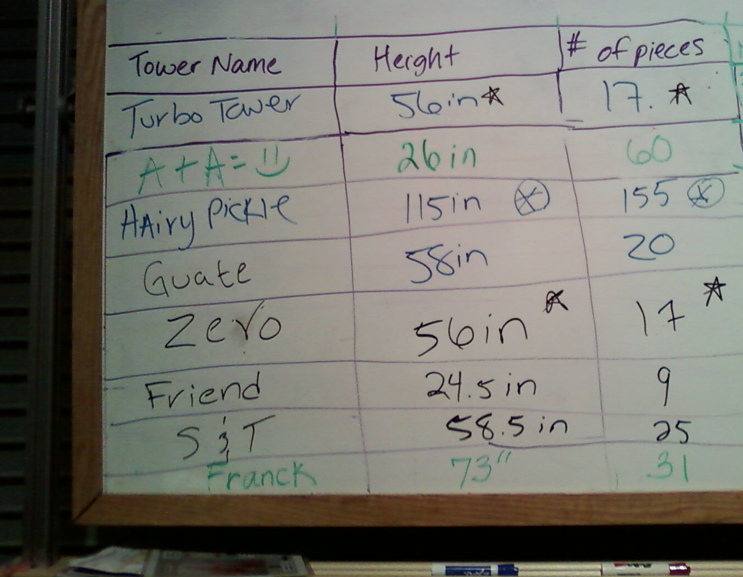
For completeness sake, we measured the tower and counted the pieces. It came in at a record breaking 199.25". I insisted we measure it in people, and found it was three friends tall.


Based on how fast the four of us worked, I estimated there were 800 pieces in the tower. The actual answer? 748!


We win. Take that small children.

November 4, 2010

Riku Costume


Difficulty: Hard
Time: 40+ hours
Price: About $100

I played Kingdom Hearts II this summer and loved it. I really wanted to be Riku for Halloween, but was a little nervous about tackling the seaming involved in making the vest (especially after I encountering it when I made the Organization Coat). But then I thought about the other two costumes I was considering - Marth with the armor and Balthier with the crazy vest and pants and then I decided it wouldn't be that bad.
The costume itself had some really hard parts (ugh! The vest!), but since it was three different big pieces, it broke up the work.

Alas, I was not able to get a good photo of me in the costume, but I'm planning on doing a legit photoshoot with it as soon as my camera wielding friend and I are not swamped with homework.

One nice thing about Riku's clothes is that they are more or less normal. I was able to base all three sewed pieces off of patterns. I used a generic button up shirt pattern for both the shirt and vest - I just got rid of the darts to make it boy shaped.

Black shirt:
All I did with this was follow the pattern. It was that easy. I wanted to do the zipper accurately, so I bought a second grey zipper and slipped it's pull on. Simple as that.

White Vest:
This was the killer part. I used the same shirt pattern as a guideline, making it a size bigger to go over the undershirt, but I had to do quite a few modifications because of the strange seams and collar. For all the seams, I marked where they would be, cut along the line, and then inserted a two inch thick piece of fabric with half inch seam allowances in. This made the desired one inch seam in the middle of the vest.


Unfortunately, one can see the yellow lining through white fabric, so I had to add an extra white layer in the middle. The zipper was from this shop.

Pants:
I traced a super baggy pair of pants. The pockets were a challenge to put on after the fact, so I would recommend attaching them before assembling the pants. Nothing special here.

Shoes:
I painted a pair of knock-off white Adidas and stole my brother's orange shoe laces.

I was pleasantly mobile in the costume. Here, I am pwning other people at a chopstick race at the Halloween party I wore this to.

And also wreaking zombie mummy havoc.